JerseyTome Research Team
May 10, 2026 · 15 min read· Verified collectors & authenticators
Cuatro Metros y Medio
6 de febrero de 1988. Chicago Stadium. El viejo coliseo en West Madison Street — el edificio que llamaban el Manicomio de Madison — albergaba el NBA All-Star Weekend por primera vez desde 1973. La afición local no era simplemente ruidosa. Era territorial. Esta era la casa de Jordan. Y la final del Concurso de Clavadas estaba a punto de producir el momento más repetido en la historia del baloncesto.
Michael Jordan se paró en la línea de fondo. Camiseta blanca. Número 23. All-Star de la Conferencia Este. Comenzó trotando, luego corriendo, luego esprintando a toda la longitud de la cancha. Sujetó el balón con la mano derecha. En la línea de tiros libres — a cuatro metros y medio de la canasta — su pie izquierdo tocó el piso por última vez. Después, debajo de él solo había aire.
Lengua afuera. Piernas abiertas. El brazo derecho extendiendo el balón hacia el aro como si alcanzara algo en un estante alto. La clavada en sí fue casi una ocurrencia tardía — el vuelo era lo importante. Permaneció en el aire el tiempo suficiente para que 18,403 personas perdieran colectivamente la razón, y luego la hundió con violencia.
50 perfecto. Campeón del Concurso de Clavadas. Y cuarenta y cinco minutos después, anotó 40 puntos para ganar el MVP del All-Star Game.
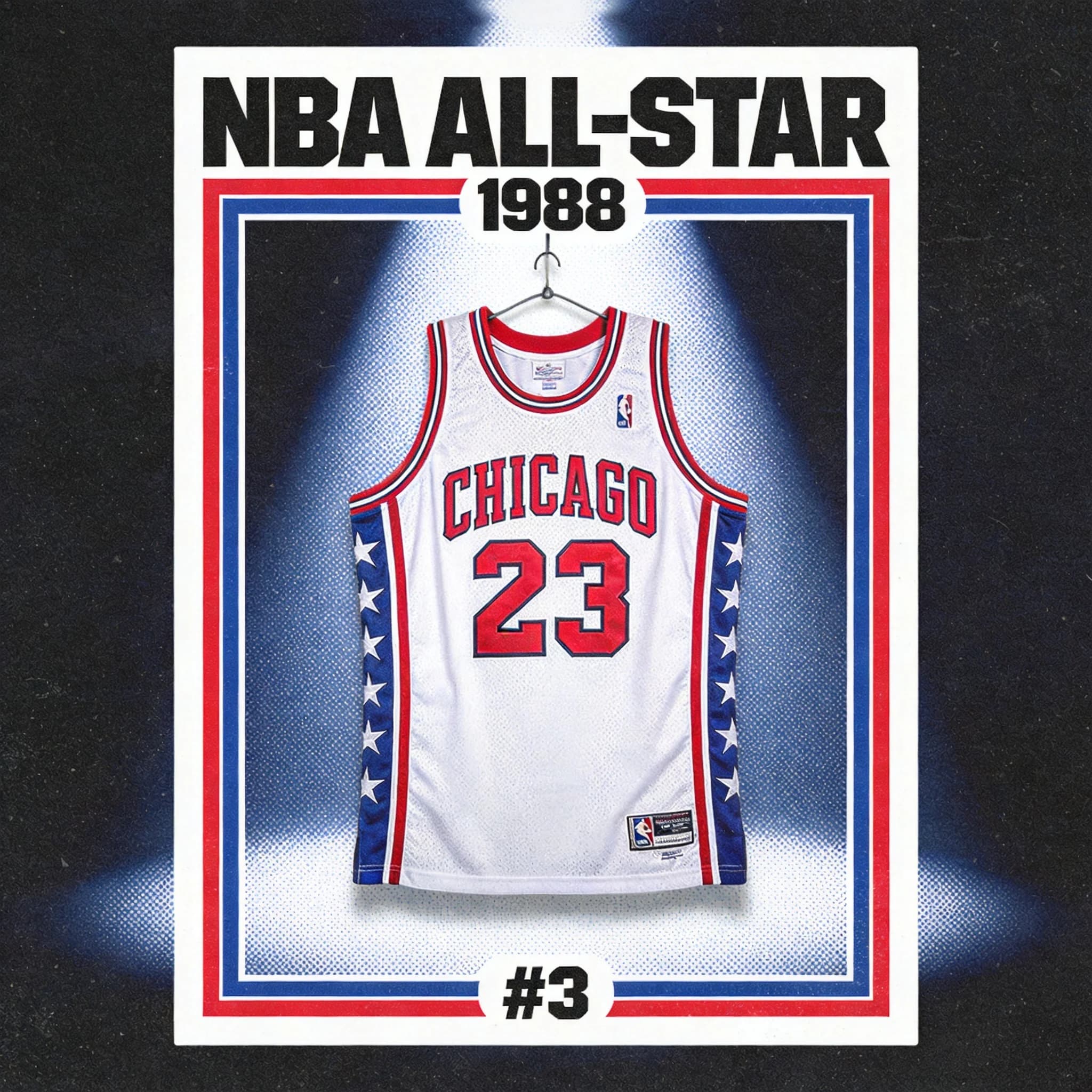
La camiseta blanca de la Conferencia Este que vistió esa noche se convirtió en algo más que tela. Se convirtió en el uniforme del vuelo humano.
La actuación de Jordan en el All-Star Game de 1988 está casi completamente eclipsada por el concurso de clavadas. Anotó 40 puntos con un 17-de-23 en tiros de campo en el partido real — la mayor producción anotadora en un All-Star Game desde los 42 de Wilt Chamberlain en 1962. También sumó 8 rebotes, 3 asistencias, 4 robos y 4 bloqueos. Fue posiblemente la actuación individual más dominante en un All-Star Game de la historia. Pero nadie habla de ello porque el concurso de clavadas ocurrió primero.
El Concurso de Clavadas: Ronda por Ronda
El Concurso de Clavadas de 1988 no fue solo Jordan contra la gravedad. Fue Jordan contra Dominique Wilkins — el Human Highlight Film — en lo que sigue siendo la final de concurso de clavadas más debatida en la historia de la NBA. Comprender la secuencia completa importa, porque la camiseta absorbió cada momento.
El formato: Tres clavadas por ronda en la final, puntuadas de 0 a 50 por un panel de cinco jueces (10 puntos cada uno). Jordan y Wilkins habían dominado la ronda preliminar para llegar a la final.
Wilkins abrió con un estruendoso molino de viento a dos manos desde la línea de fondo. Pura violencia. El tipo de clavada que te hace verificar la integridad estructural del aro. Puntuación: 49.
Jordan respondió con una clavada corriendo a una mano desde el lado izquierdo, despegando desde bien afuera de la zona pintada. Suave donde Wilkins era poderoso. Puntuación: 49.
La segunda clavada de Wilkins — una reversión a dos manos con doble bombeo que requería atrapar su propio impulso en el aire y redirigirlo. La afición de Atlanta en casa estaba gritando. Puntuación: 49.
La segunda de Jordan — la famosa clavada del "beso al aro". Se elevó desde la línea de fondo izquierda, llevó el balón al nivel del aro, pareció sostenerlo brevemente allí (besando el aro), y luego lo hundió con fuerza. Puntuación: 50.
La clavada final de Wilkins fue un feroz molino de viento que sacudió el tablero. Otro 49. Su total: 147 de 150. En cualquier otro año, contra cualquier otro ser humano, eso gana.
Entonces Jordan caminó hasta la línea de fondo opuesta. La pista de carrera a toda la cancha. El Chicago Stadium ya estaba de pie. Comenzó a correr.
Puntuación: 50. Total: 148. Campeón por un solo punto.
“Podías sentir el edificio moverse. No estoy siendo poético — el viejo Chicago Stadium tenía un balcón que literalmente temblaba cuando la multitud pisoteaba. Cuando Michael despegó desde la línea de tiros libres, pensé que la parte alta se iba a derrumbar.”
— Ahmad Rashad, reportero de cancha de NBC, All-Star Weekend 1988
La Controversia que No Muere
Dominique Wilkins anotó 147 de 150 y perdió. Treinta y ocho años después, todavía no ha hecho las paces del todo con ello.
El argumento es simple: las clavadas de Wilkins fueron más poderosas, más atléticas, más difíciles — y los jueces locales le dieron a Jordan puntuaciones infladas porque era Chicago. El contraargumento es igual de simple: las clavadas de Jordan fueron más creativas, más estéticamente completas, y la clavada desde la línea de tiros libres fue la mayor jugada individual en la historia del concurso.
La verdad se sitúa en el medio. Ambos hombres fueron trascendentes esa noche. Wilkins merecía un título. Jordan lo obtuvo en parte porque la multitud — su multitud — creó una atmósfera que hizo que cada clavada de Jordan se sintiera como una experiencia religiosa. Los jueces eran humanos. Los humanos responden cuando 18,403 personas pierden la razón.
Pero esto es lo que la controversia hizo por la camiseta: le dio tensión narrativa. Esta no es solo la camiseta de una victoria — es la camiseta de una victoria disputada, una obra maestra debatida, una noche que los aficionados al baloncesto todavía discuten en los bares. Ese tipo de fricción cultural permanente es lo que separa un artículo de colección de un artefacto.
Julius Erving realizó una clavada desde la línea de tiros libres en el Concurso de Clavadas de la ABA en 1976 — doce años antes que Jordan. Pero la versión de Erving tenía diferencias clave: fue en la ABA (menor alcance cultural), la carrera fue más corta y, fundamentalmente, nadie la filmó con la calidad de producción que NBC llevó al Chicago Stadium. La versión de Jordan no solo replicó la clavada — la replicó en el escenario más grande, en su propio recinto, contra el mejor clavadista vivo, con cámaras capturando cada ángulo. La ejecución es invención cuando el mundo entero está mirando.
La Camiseta: Diseño y Detalles
La camiseta del NBA All-Star 1988 pertenece a una era específica del diseño de uniformes All-Star — antes de que Nike homogeneizara las plantillas, antes de que las estéticas "fashion-forward" de las ediciones City tomaran el control. Es limpia, institucional e inconfundiblemente de los años 80.
Color: Base blanca. La camiseta de la Conferencia Este era blanca; la Conferencia Oeste vestía de rojo. Esto importa para los coleccionistas — Jordan siempre aparece en la camiseta blanca del All-Star para 1988.
Letras: "EAST" en el pecho en letras azules de bloque con bordes rojos. No "Eastern Conference", no "All-Stars" — solo "EAST". La simplicidad es parte del encanto.
Número: #23 en azul con contorno rojo en la espalda. El mismo número que Jordan usaba con los Bulls, pero renderizado en la combinación de colores del All-Star. El frente también presenta un #23 más pequeño en el área izquierda del pecho.
Bordes: Ribetes azules y rojos a lo largo del cuello, sisas y paneles laterales. La combinación de colores es distintivamente patriótica — rojo, blanco y azul — lo cual era estándar para los uniformes del NBA All-Star de esa era.
Fabricante: Medalist Sand-Knit, que tenía el contrato de uniformes de la NBA en 1988. Las camisetas Sand-Knit tienen un peso y tacto de malla distintivos, notablemente diferentes de las eras de Champion y Nike que siguieron.
Parche: El logo del NBA All-Star Game 1988 — específico del evento de Chicago — aparece en la camiseta. Este parche es un punto clave de autenticación y una razón principal por la que los coleccionistas prefieren la reproducción de M&N sobre réplicas genéricas de la Conferencia Este.
Las Zapatillas: Jordan calzó las Air Jordan III — el primer diseño de Tinker Hatfield, con la unidad Air visible y el estampado de elefante. El colorway White Cement combinado con la camiseta blanca del All-Star creó un look monocromático de pies a cabeza que estaba adelantado a su tiempo. Las AJ3 y esta camiseta están permanentemente vinculadas en la cultura cruzada de zapatillas y camisetas.
“Ese All-Star Weekend de 1988 fue la coronación de Michael. Tenía 24 años. Ganó el concurso de clavadas y el MVP en su propio edificio. Después de ese fin de semana, ya no había debate sobre quién era el mejor jugador del mundo.”
— Sam Smith, autor de 'The Jordan Rules'
Chicago Stadium: El Edificio que Creó el Momento
No se puede separar esta camiseta de su recinto. El Chicago Stadium — demolido en 1995 para dar paso al United Center — era una arena de 1929 construida para hockey y boxeo. Albergaba 18,676 personas para baloncesto. Tenía un órgano de tubos. El balcón superior era tan empinado y estaba tan cerca de la cancha que los jugadores lo describían como "jugar dentro de un tambor".
La acústica era la clave. Las arenas modernas están diseñadas para distribuir el sonido. El Chicago Stadium estaba diseñado para contenerlo. Cuando 18,000 personas gritaban, el sonido no tenía adónde ir. Rebotaba en paredes de concreto y vigas de acero y volvía más fuerte. Jugadores de equipos visitantes describían una genuina desorientación — el ruido era físico, no solo audible.
Jordan en 1988 no estaba simplemente clavando frente a una multitud. Estaba clavando dentro de un arma sónica. Cada despegue era acompañado por un muro de ruido que hacía que el momento se sintiera más grande que el deporte. Los jueces lo sintieron. La audiencia de televisión lo escuchó. Y la camiseta estaba en el medio de todo ello.
Cuando los coleccionistas sostienen una camiseta del All-Star 1988, sostienen una pieza de un edificio que ya no existe, de una noche que nunca podrá ser recreada, en un deporte que desde entonces ha relegado su concurso de clavadas a los márgenes del All-Star Weekend. La escasez no es solo física — es temporal.
Por Qué Esta Camiseta Es un Santo Grial
La camiseta del All-Star 1988 de Michael Jordan se sitúa en la intersección de múltiples factores de coleccionismo, cada uno de los cuales independientemente haría valiosa a una camiseta:
1. Momento definitorio en la historia del baloncesto. La clavada desde la línea de tiros libres está en el top-3 de cualquier lista de los momentos más grandes de la NBA. Es el clip más utilizado en los resúmenes de highlights de baloncesto. La camiseta es el ancla visual.
2. Cancha local. Jordan realizó la clavada en Chicago, frente a sus propios aficionados. Esto no fue una hazaña de visitante — fue una coronación. El peso emocional de "chico local gana en casa" añade una capa de valor narrativo.
3. Doble logro. Campeón del concurso de clavadas Y MVP del All-Star Game en el mismo fin de semana. Ningún otro jugador ha dominado un All-Star Weekend tan completamente antes o desde entonces. La camiseta representa dos trofeos, no uno.
4. Diseño de una sola noche. A diferencia de las camisetas de los Bulls que Jordan usó en cientos de partidos, la camiseta del All-Star 1988 se usó un solo fin de semana. Los uniformes del All-Star cambian cada año. Este diseño específico — esta exacta combinación de blanco, bordes azules, letras EAST, malla Sand-Knit — existió para un solo evento. Eso es escasez incorporada.
5. Jordan pre-campeonato. En 1988, Jordan no había ganado un título todavía. Tenía 24 años — puro atletismo, puro potencial, la expresión más pura del genio físico del baloncesto antes de la madurez estratégica de los años de campeonato. Los coleccionistas valoran esta era porque captura a Jordan en su momento más explosivo. La camiseta del All-Star 1988 es el ápice del "Jordan joven".
6. La conexión con las zapatillas. Las Air Jordan III, usadas con esta camiseta, son ampliamente consideradas las zapatillas que salvaron el acuerdo de Jordan con Nike. El primer diseño de Tinker Hatfield para Jordan. La combinación de esta camiseta y las AJ3 White Cement es un momento fundacional en la cultura sneaker.
Guía de Autenticación
La autenticación de una camiseta del All-Star 1988 depende en gran medida de lo que estés comprando:
Mitchell & Ness Hardwood Classics (producción actual):
- Etiqueta holográfica en la cadera izquierda — debe cambiar de color al inclinarla bajo la luz. Las etiquetas impresas son falsificaciones.
- Letras y números de tackle twill — multicapa, bordes termosellados. Las falsificaciones usan serigrafía o planchado de una sola capa.
- Peso — una M&N auténtica pesa aproximadamente 380g (talla L). Si se siente ligera como una camiseta, es falsa.
- El parche del All-Star Game 1988 debe estar bordado, no impreso. Verifica la densidad del hilo — los parches auténticos tienen costuras apretadas y uniformes.
Originales vintage Sand-Knit (venta al público de 1988):
- Etiqueta Sand-Knit / Medalist dentro del cuello — tipografía y diseño específicos del período de contrato 1987-89.
- La construcción de malla es más pesada y rígida que las camisetas de la era Champion. La mezcla de poliéster tiene un tacto distintivo.
- Etiqueta de identificación en el dobladillo izquierdo con talla, instrucciones de lavado y marca Sand-Knit.
- Precisión del color — el azul debe ser un azul real verdadero, no navy (demasiado oscuro) ni azul cielo (demasiado claro). Compara con fotos del partido.
Usadas en juego (extrema rareza):
- La comparación fotográfica es esencial. El All-Star Weekend 1988 fue ampliamente fotografiado y televisado — hay abundante material de referencia.
- LOA (Carta de Autenticidad) de la NBA y del equipo de un servicio de autenticación reconocido (MeiGray, Resolution Photomatching).
- Evidencia de uso en juego: cuello estirado, ligero desgaste por fricción en áreas de alto contacto, posibles manchas de sudor.
- Jordan usaba talla 46-48. Cualquier pieza usada en juego que afirme ser de Jordan debe estar en este rango.
Guía de Compra: Dónde Encontrarla
Mitchell & Ness directo: El camino más seguro. Su camiseta Authentic Hardwood Classics del All-Star 1988 es una reproducción fiel con tackle twill adecuado, el parche del All-Star Game y colores correctos. El precio de venta es $300. El inventario rota — si tu talla está agotada, revisa trimestralmente. Mitchell & Ness repone periódicamente las camisetas All-Star de Jordan porque siguen siendo de sus productos más vendidos.
GOAT: La plataforma ofrece reproducciones M&N a precio de venta o cercano. La capa de autenticación añade confianza. Existen primas por talla — XL y XXL a menudo se negocian entre un 15-20% por encima del precio de venta debido a la demanda del mercado cruzado con el streetwear.
eBay: La selección más amplia pero el mayor riesgo. Originales vintage Sand-Knit aparecen aquí ocasionalmente, junto con reproducciones M&N y un volumen significativo de falsificaciones. Usa la guía de autenticación anterior. Filtra por listados con "garantía de autenticidad" al comprar M&N. Para vintage, insiste en fotos detalladas de la etiqueta de identificación, etiqueta del cuello y primer plano de la malla antes de comprar.
Casas de subastas (Sotheby's, Heritage, Grey Flannel): El único canal legítimo para piezas usadas en juego. Las camisetas del All-Star Game aparecen ocasionalmente en grandes subastas de memorabilia deportiva. Espera precios de seis cifras y pujas intensas para cualquier cosa confirmada de Jordan.
Qué evitar: Listados de Amazon por menos de $50 (falsificaciones), cualquier vendedor que afirme "game-issued" sin documentación de la NBA, y vendedores en el extranjero que envían desde ubicaciones inconsistentes con la procedencia declarada.
El Legado del Vuelo
El NBA All-Star Weekend de 1988 fue el momento en que el baloncesto se elevó por los aires. No solo como deporte — como concepto. Jordan no solo ganó un concurso de clavadas. Demostró que un ser humano podía hacer algo con un balón de baloncesto que parecía imposible, y lo hizo con una camiseta blanca con "EAST" en el pecho en un edificio que temblaba cuando la gente gritaba.
Nike construyó toda la mitología de "Air Jordan" sobre este momento. El logo del Jumpman — la silueta de Jordan en vuelo — se inspira en el lenguaje visual de la clavada desde la línea de tiros libres. Cada comercial de Air Jordan que muestra una silueta contra el cielo, cada póster "Wings", cada referencia a "Be Like Mike" traza su ADN visual hasta el 6 de febrero de 1988.
La camiseta es el punto de origen. Antes de los campeonatos, antes del Dream Team, antes de The Last Dance — había un joven de 24 años con una camiseta blanca de All-Star, corriendo a lo largo de la cancha, despegando desde la línea de tiros libres y negándose a descender.
Por eso los coleccionistas la quieren. No porque sea rara (aunque lo es). No porque sea valiosa (aunque el mercado lo confirma). Sino porque es la camiseta que estaba sobre el cuerpo de Michael Jordan en el momento exacto en que se convirtió en Michael Jordan — la idea, el ícono, el logo, la leyenda.
Despegó desde la línea de tiros libres. Realmente nunca aterrizó.
Where to Buy
Affiliate links — we earn a small commission at no extra cost to you. Prices as of last update; click through for current pricing.
Acquire This Jersey
Affiliate links — we earn a small commission at no extra cost to you.
Resale Price Trend
+28.6%Herramientas para Coleccionistas
Divulgación de afiliados: Algunos enlaces nos generan una pequeña comisión sin costo adicional para ti. Solo recomendamos productos que compraríamos nosotros mismos.