JerseyTome
이 페이지는 아직 번역되지 않았습니다. 영어 버전을 표시합니다.
Player Legend / 1990s

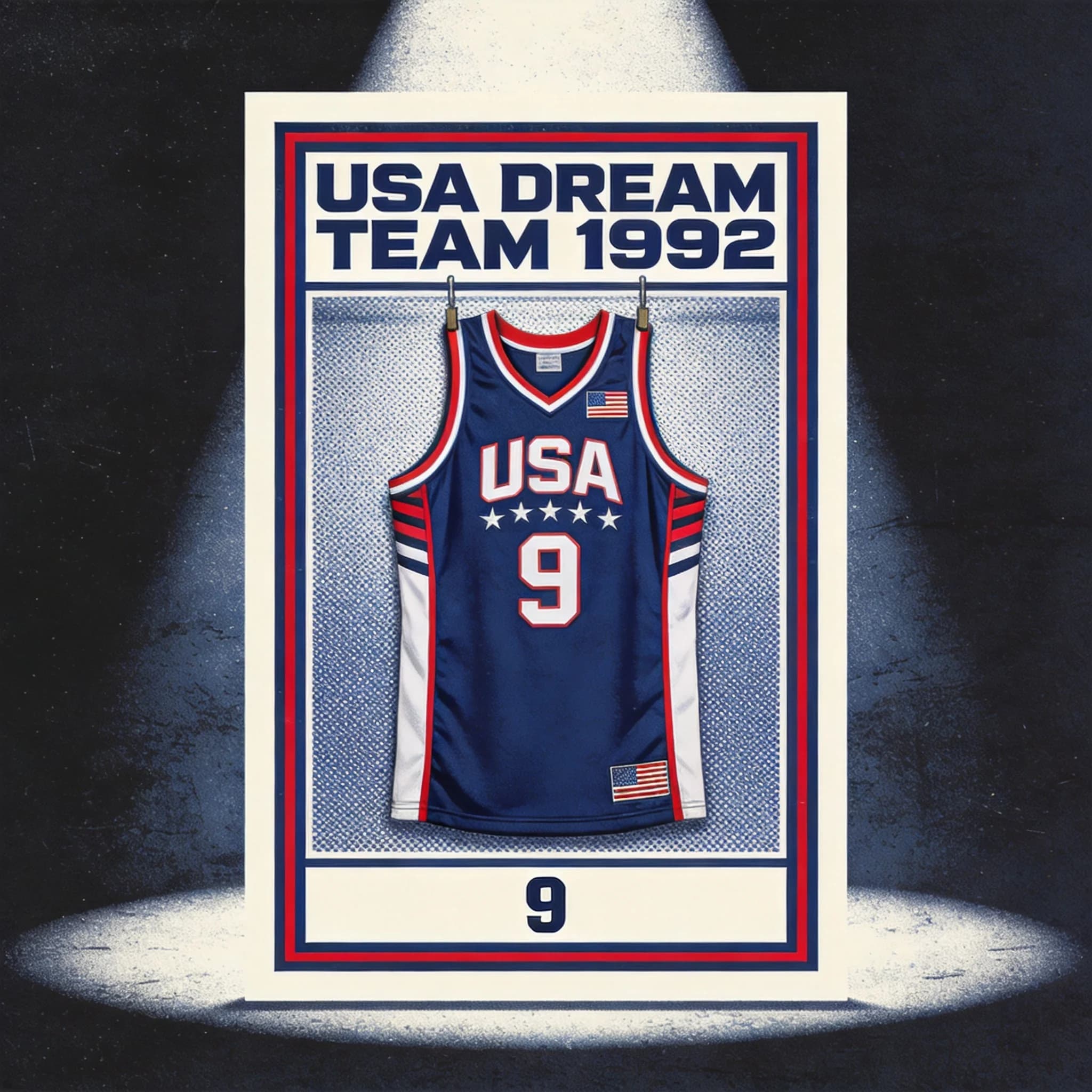
The Jersey That United Rivals — Jordan's 1992 Dream Team USA #9

Michael Jordan traded Bulls red for American red, white, and blue at the Barcelona Olympics. The Dream Team jersey isn't just a basketball collectible — it's a Cold War victory lap stitched into mesh.

Gold Medal
Olympic Result
#9
Jersey Number
+43.8 pts
Avg Margin
The Jersey That United Rivals — Jordan's 1992 Dream Team USA #9
Share
JT

JerseyTome Research Team

May 10, 2026 · 13 min read· Verified collectors & authenticators

The Summer Basketball Became America's Export

Before the Dream Team, Olympic basketball was an afterthought for American sports fans. College kids represented the United States. Some years they won gold. Some years they didn't. Nobody outside the basketball world particularly cared.

Then FIBA changed its rules. Starting in 1992, professional NBA players could compete in the Olympics. And the United States responded by assembling a roster so absurdly stacked that calling it a "team" felt like calling a nuclear weapon a "device."

Michael Jordan. Magic Johnson. Larry Bird. Charles Barkley. Patrick Ewing. Karl Malone. John Stockton. Chris Mullin. Clyde Drexler. David Robinson. Scottie Pippen. Christian Laettner.

Eleven future Hall of Famers. The twelfth was a college kid from Duke who happened to be the reigning national player of the year. They wore white jerseys with "USA" across the chest, red and blue trim down the sides, and numbers that meant nothing — because these men were already beyond numbering.

Jordan drew #9. Not his choice. USA Basketball assigned it. And for one summer, the most famous #23 in the world became the most famous #9.

The Number Nobody Chose

USA Basketball assigned jersey numbers 4 through 15 to the 12-man roster. The allocation was essentially administrative — not based on seniority, stats, or preference. Jordan got #9, Magic got #15, Bird got #7. The randomness is part of the charm: these men were so transcendent that the number on the jersey was irrelevant. They were recognizable from any seat in any arena on earth.

Barcelona, 1992: A Victory Lap Disguised as Competition

The 1992 Barcelona Olympics weren't a basketball tournament. They were an exhibition with a gold medal attached.

The Dream Team won their eight games by an average of 43.8 points. Their closest contest was a 32-point victory over Croatia in the gold medal game. Opposing players asked for autographs before tipoff. Angola's coach said after losing 116-48: "It was the best moment of my life."

This wasn't sport in the traditional sense. It was a cultural event — the United States showcasing its NBA superstars to a global audience that had only seen them on grainy television broadcasts. For billions of people worldwide, Barcelona 1992 was their first real encounter with Michael Jordan, Magic Johnson, and Larry Bird. The Dream Team didn't just win gold. They made basketball a global language.

The Flag Incident: Nike vs. Reebok on the Podium

Here is the story that elevated the Dream Team jersey from sports memorabilia to cultural artifact.

Reebok had the official sponsorship deal for USA Basketball's podium warmup suits. Every player was contractually required to wear Reebok during the medal ceremony. Jordan, the world's most prominent Nike athlete, refused.

Not quietly. Not diplomatically. Jordan told USA Basketball officials he would skip the medal ceremony entirely rather than wear a competitor's logo. So did Charles Barkley. The standoff threatened to derail the single most triumphant moment in American basketball history.

The compromise: Jordan wore the Reebok jacket but draped an American flag over his right shoulder, concealing the Reebok logo entirely. Barkley did the same. In photographs from the medal ceremony, you see twelve men on the podium — and two of them are wrapped in flags while the other ten show Reebok branding.

The image became one of the most reproduced sports photographs of the 1990s. And the jersey beneath the flag — the white USA #9 — became inseparable from the story. It's not just a basketball jersey. It's a symbol of the moment when athlete branding became more powerful than Olympic tradition.

I have two million reasons not to wear Reebok.

Michael Jordan, reportedly to USA Basketball officials before the 1992 medal ceremony, referring to his Nike contract

Design Breakdown: Red, White, and Blue — Simplified

The 1992 USA Basketball jersey is an exercise in restrained patriotism. Where the NBA's 1990s aesthetic ran toward pinstripes, teal explosions, and purple dinosaurs, the Dream Team jersey was deliberately classic.

The White Base: Clean, bright, Olympic white. Under arena lights in Barcelona's Pavello Olimpic, the jerseys practically glowed. The white was a conscious choice — it photographed beautifully for international television audiences encountering these players for the first time.

The Side Panels: Red and blue vertical stripes running from armhole to waist. Not gradient, not faded — solid blocks of color creating the American tricolor when the jersey was viewed from the front. Simple geometry, maximum impact.

"USA" Wordmark: Navy blue block letters across the chest, arched slightly. No serifs, no outlines, no drop shadows. The lettering style was closer to military stencil than sports branding — an appropriate aesthetic for what was essentially an American athletic invasion of Europe.

The Number: Jordan's #9 in red with navy blue outline. Single-layer screen printing on retail Champion versions; tackle twill on game-issued Nike pieces. The number sits lower on the chest than standard NBA placement, a USA Basketball design quirk that makes Dream Team jerseys instantly distinguishable even in silhouette.

The Back: "JORDAN" in navy blue block letters above the #9. Same restrained typography. No logos, no additional branding. The nameplate is the authenticator — and the reason this jersey exists in a different collecting universe than generic "USA #9" pieces.

The Manufacturing Split

Here's the detail that confuses collectors: two different companies made Dream Team jerseys in 1992. Nike produced the on-court game jerseys worn by the actual players during Olympic competition. Champion — which held the NBA's retail license — produced the consumer replicas sold in stores. This means an "authentic 1992 Dream Team jersey" could be either Nike or Champion, depending on whether you mean game-worn or retail. Both are legitimate. Both are collectible. But they're different products with different authentication markers.

The Dream Team's Meaning Beyond Basketball

It is impossible to separate the Dream Team jersey from its geopolitical context.

The Cold War had ended two years earlier. The Soviet Union dissolved in December 1991. The 1992 Olympics were the first Summer Games without a Soviet team. The "Unified Team" — a collection of former Soviet republics competing under the Olympic flag — was a transitional ghost. For decades, USA vs. USSR basketball had been a genuine rivalry (the controversial 1972 gold medal game still haunts American basketball). In 1992, there was no rival. There was just America and everyone else.

Globalization was accelerating. Barcelona '92 was the first Olympics broadcast live to a truly global satellite television audience. The NBA had been working to expand internationally since the mid-1980s. The Dream Team was the marketing payload — twelve arguments for why every kid in Manila, Lagos, and Belgrade should care about the NBA.

It worked. The Dream Team's Barcelona run is credited with igniting basketball's global explosion. Within a decade, international players like Dirk Nowitzki, Tony Parker, Manu Ginobili, and Yao Ming would transform the NBA. That pipeline traces directly back to billions of people watching Jordan, Magic, and Bird dismantle opponents in white USA jerseys during the summer of 1992.

The Dream Team jersey isn't memorabilia from a basketball game. It's memorabilia from a cultural moment — the moment American basketball became the world's game.

I don't think you'll see another team like this. It was eleven of the twelve greatest players who ever lived, in the same uniform, at the same time. That doesn't happen in basketball. That doesn't happen in any sport.

Chuck Daly, Dream Team head coach

Why Jordan's #9 Specifically?

Eleven of the twelve Dream Team members are Hall of Famers. Why does Jordan's jersey command the market premium?

He was the alpha. Magic was retired (he'd come back to HIV and a farewell). Bird's back was destroyed (Barcelona was his final competitive basketball). Jordan was in his absolute prime — 29 years old, coming off his second consecutive NBA championship, the undisputed best player on the planet. When you wore a Dream Team jersey in 1992, you wore Jordan's number.

The crossover factor. A Jordan Dream Team jersey sits at the intersection of multiple collector communities: Jordan completists, Olympic memorabilia collectors, USA Basketball historians, and 1990s nostalgia collectors. That Venn diagram overlap creates demand density that no other Dream Team player's jersey matches.

Only Olympic appearance. Jordan never played in another Olympics. This was it — one summer, eight games, gold medal, done. The scarcity of the context elevates the jersey above any single NBA season piece, which was one of 82 regular-season appearances.

How to Authenticate a Dream Team Jersey

The dual-manufacturer situation makes Dream Team authentication more complex than standard NBA jerseys. Here's what to look for:

1. Champion Retail (1992-93 production): The most common vintage pieces. Look for the Champion "C" logo tag on the left hem. Mesh construction. Screen-printed numbers and lettering. The "USA" wordmark should be navy blue with clean edges. Jock tag on the lower left front with size, care instructions, and "Made in USA" (most Champion production was domestic in this era). Counterfeits often use glossy screen printing — originals have a matte finish.

2. Nike Game-Issued / Game-Worn: Extremely rare and expensive. Nike Swoosh on the right chest area. Heavier mesh than Champion retail. Tackle twill numbering and lettering. Fight strap (a small loop of fabric inside the back hem, used to tuck the jersey into shorts). If someone claims to have a Nike game-issued Dream Team jersey, demand provenance documentation — these pieces are five- to six-figure items and should come with authentication from a recognized service.

3. Mitchell & Ness (Modern Reproduction): The most accessible quality option. M&N Hardwood Classics tag inside the collar. Tackle twill lettering. The "1992" year will appear on the tag. Holographic authentication sticker on the left hip — tilt it to verify the color shifts. These are licensed reproductions, not counterfeits.

4. Color Accuracy: The navy blue in "USA" and the number outline should be a true dark navy — Pantone 289C or very close. Fakes frequently go too light (royal blue) or too dark (almost black). Compare against official USA Basketball imagery.

5. Star Pattern: Authentic pieces feature small white stars integrated into the side panel design. On counterfeits, these stars are often misaligned, incorrectly sized, or missing entirely. Count them and compare to reference images.

Market Dynamics and Timing

The Dream Team jersey market moves on specific cycles:

Olympic years spike demand. Every four years — 2024 Paris, 2028 Los Angeles — Dream Team nostalgia resurfaces. Prices rose 15-20% in the months surrounding the 2024 Paris Games and will likely surge again before LA 2028, especially with the Olympics on American soil for the first time since 1996.

Documentary releases create windows. The Last Dance (2020) spiked all Jordan memorabilia by 30-50%. Any future documentary focusing on the Dream Team — and there will be one — will trigger a similar surge.

The generational shift is real. Collectors who watched Barcelona live in 1992 are now in their 40s and 50s — peak earning years combined with peak nostalgia. This demographic is actively building collections, and the Dream Team jersey is a centerpiece acquisition.

Condition matters enormously for vintage. A 1992 Champion jersey with original tags commands 3-5x the price of the same jersey worn and washed. The polyester mesh from this era yellows with age if stored improperly. Climate-controlled, dark storage is essential for preservation.

The Sneaker Connection

Jordan wore the Air Jordan VII "Olympic" colorway during the Dream Team's Barcelona run — white, midnight navy, and true red, designed to match the USA Basketball uniform. Unlike the accidental pairing of the Air Jordan XI with the pinstripe, this match was entirely intentional. Tinker Hatfield designed the VII Olympic colorway specifically for the 1992 Games.

The Air Jordan VII Olympic has been retroed multiple times (1999, 2004, 2012, 2023) and remains one of the most beloved Jordan colorways. Collectors who display the Dream Team jersey alongside the matching VII create what the community calls a "Barcelona set" — the jersey-shoe pairing that represents the peak of early 1990s Jordan.

The Verdict

Every other jersey on this site represents a player and a franchise. The 1992 Dream Team jersey represents a player and a country — and a specific moment when basketball stopped being an American sport and became a global one.

Jordan has more iconic jerseys. The Bulls red defined his dynasty. The pinstripe captured his peak season. The UNC blue started his legend.

But the Dream Team #9 is the one that connected him to something larger than the NBA. It's the jersey that introduced Michael Jordan to the world — literally, to billions of people who had never seen him play. It's the jersey draped beneath an American flag on a podium in Barcelona. It's the jersey that turned basketball into earth's second language.

For collectors, it occupies a unique space: affordable enough at the replica tier to be accessible, rare enough at the vintage tier to be aspirational, and culturally significant enough at every tier to be worth owning. No other jersey in the Jordan timeline carries this particular combination of patriotic symbolism, historical weight, and global reach.

Eight games. 43.8-point average margin. Gold medal. The greatest team ever assembled, wearing the simplest jersey imaginable.

That's the Dream Team. That's the #9.

Where to Buy

Affiliate links — we earn a small commission at no extra cost to you. Prices as of last update; click through for current pricing.

Acquire This Jersey

Affiliate links — we earn a small commission at no extra cost to you.

Resale Price Trend

+36.4%
$300$2202024-Q12025-Q2

제휴 공시: 일부 링크를 통해 소액의 수수료를 받을 수 있으며, 추가 비용은 발생하지 않습니다. 직접 구매할 제품만 추천합니다.
자주 묻는 질문

Why did Michael Jordan wear #9 on the Dream Team instead of #23?

USA Basketball assigned numbers 4 through 15 to the 12-man roster. Jordan received #9 — the number wasn't chosen by the players but allocated by the federation. Other notable assignments: Magic Johnson wore #15, Larry Bird wore #7, and Charles Barkley wore #14. The lack of personal number choice makes the Dream Team jersey distinctive in Jordan's wardrobe.

How much is a Michael Jordan Dream Team jersey worth?

Prices vary widely by tier. Game-worn pieces from the 1992 Olympics are essentially priceless museum items ($500K+). Original 1992 Champion retail jerseys in good condition sell for $200-$800 on eBay. Mitchell & Ness Authentic reproductions run $250-$350. Budget-friendly Nike or Fanatics replicas are available for $80-$150. The market has been steadily appreciating as 1990s Olympic nostalgia intensifies.

Was the 1992 Dream Team jersey made by Nike or Champion?

Both — but in different capacities. Champion manufactured the retail replica jerseys sold to consumers in the early 1990s. Nike supplied the on-court uniforms worn by the actual players during the Barcelona Olympics. This dual-manufacturer situation creates two distinct authentication paths for collectors: Champion tags for vintage retail pieces, and Nike details for game-worn or game-issued items.

같은 시대 다른 선수의 저지

Free for Collectors

Price Alerts & Authentication Tips

Get notified when jersey prices drop, plus weekly authentication guides from verified collectors. Join 2,000+ subscribers.

No spam. Unsubscribe anytime. Free forever.