JerseyTome Research Team
May 9, 2026 · 11 min read· Verified collectors & authenticators
The Unstoppable Force Meets the Perfect Uniform
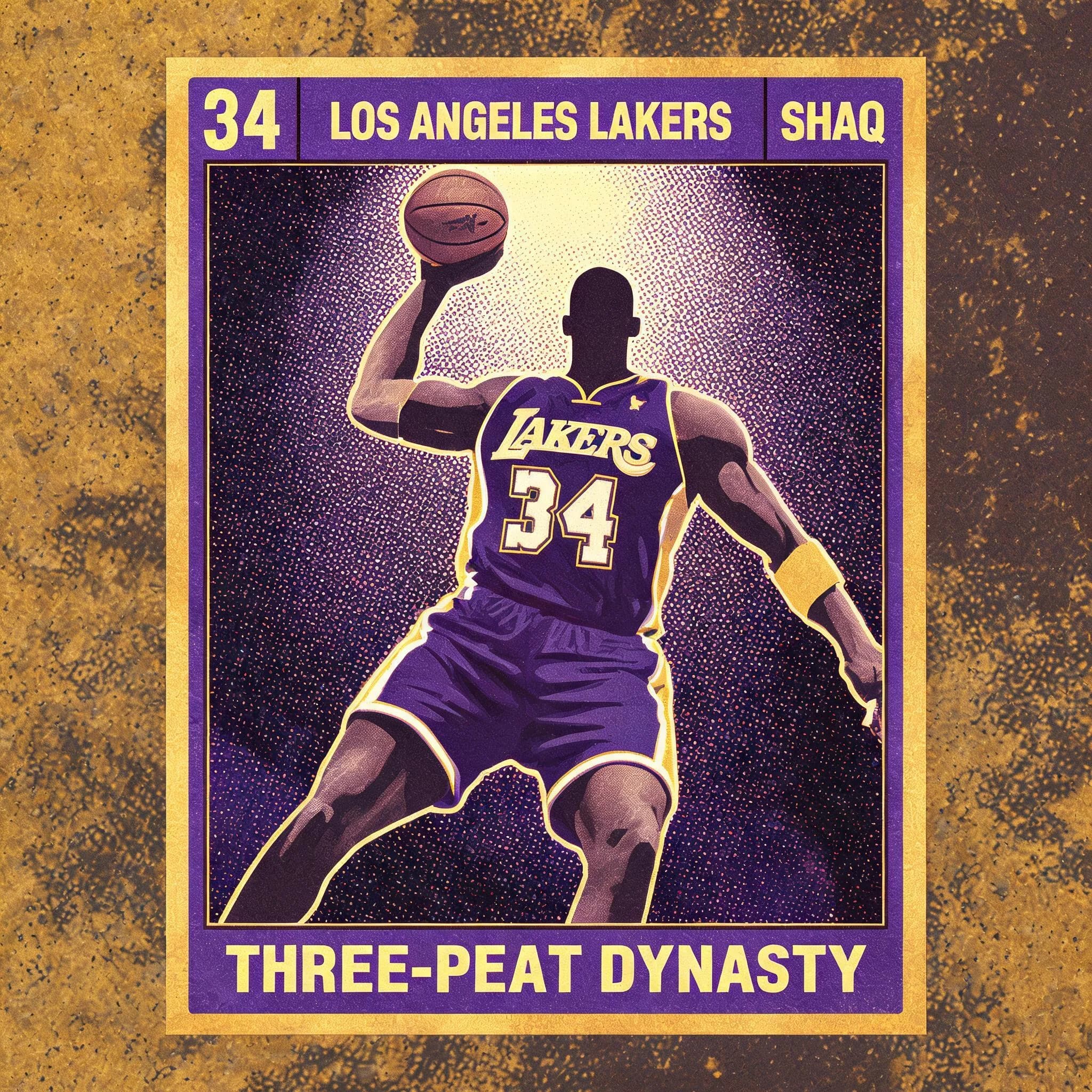
From 2000 to 2002, the Los Angeles Lakers three-peated — winning three consecutive NBA championships. The engine was Shaquille O'Neal. He won Finals MVP all three years, averaging 36 points and 15 rebounds across those three Finals series. No player in the modern era has been more dominant in championship moments.
And he did it in purple-and-gold. The most famous uniform in basketball. The jersey that Magic Johnson made legendary in the 1980s was given to a 7'1" wrecking ball who averaged 30 points and 14 rebounds for eight straight seasons in Los Angeles.
Shaq in Lakers purple is the most dominant visual in basketball history — a human being who made other professional athletes look like children, wearing the jersey of a franchise synonymous with excellence. The combination is historically unique and will never repeat.
The Three-Peat Hierarchy
Not all Shaq Lakers jerseys are equal. The market stratifies clearly by season:
2000 Finals (vs. Indiana): Shaq's first championship. He averaged 38.0 PPG and 16.7 RPG in the Finals — historically dominant. The road purple from this series is the #1 grail because it represents "the beginning." The start of a dynasty always commands a premium over its continuation.
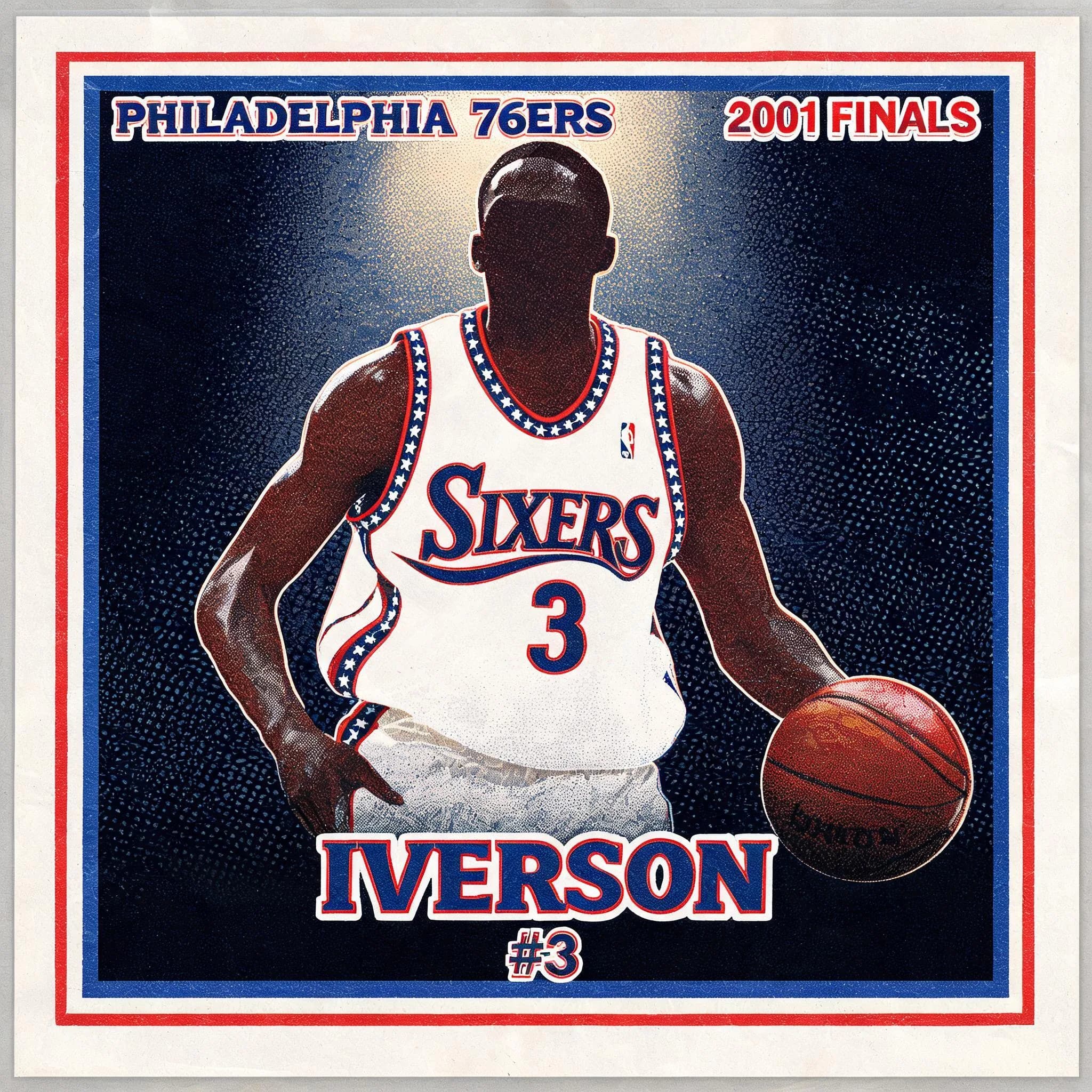
2001 Finals (vs. Philadelphia): The most dominant postseason run in NBA history. The Lakers went 15-1 in the playoffs. Shaq averaged 33 and 16 in the Finals against Dikembe Mutombo — the reigning Defensive Player of the Year. The single loss came in Game 1 (AI's iconic stepover game). But because 2001 was year two of the dynasty, jerseys trade at a 15-20% discount to 2000 pieces.
2002 Finals (vs. New Jersey): A sweep. Shaq averaged 36 and 12. But three-peat completion is, paradoxically, the least exciting championship in real-time — everyone expected it. Jerseys from this series trade at the lowest premium of the three, making them the value play for collectors who want a three-peat piece at a more accessible price.
“I knew from game one of the Finals that nobody was stopping him. Not that year, not the next year, not the year after that. Three years where nobody on Earth could guard Shaquille O'Neal.”
— Reggie Miller, on the 2000 Finals
Purple Road vs. Gold Home
The Lakers' three-peat-era jerseys featured two primary colorways:
Purple (road): This is the jersey people visualize when they think "Shaq Lakers." The deep purple with gold numbering was worn for all road Finals games — including the iconic moments: Shaq's 43-point Game 1 performance in 2000, the 15-1 playoff run of 2001. Purple commands a 25-30% premium over gold for Shaq-specific pieces.
Gold (home): Worn at Staples Center. Visually bright under arena lights. The home gold is iconic in its own right but less associated with Shaq's defining moments, which disproportionately happened on the road.
Shaq vs. Kobe: The Market Dynamic
The Shaq-Kobe Lakers era means their jersey values are interlinked. After Kobe's death in 2020, all Lakers memorabilia experienced a permanent market elevation. Shaq Lakers jerseys benefited from this tide — they appreciated 40-60% between 2020 and 2022 even though Shaq himself was unaffected.
However, Kobe's market ceiling is permanently higher than Shaq's for the Lakers era. The emotional premium of Kobe's passing creates a price floor that Shaq's market (healthy, active media personality) doesn't have. For value-conscious collectors, this means three-peat Shaq pieces offer better relative value — you get a piece of the same dynasty at a lower entry point than equivalent Kobe pieces.
Authentication
-
Size verification: Shaq game-worn pieces are size 56-60. Any claimed game-worn under 54 is fake.
-
Nike template (1996-2004): Dri-FIT mesh, Nike Swoosh on left shoulder, NBA logoman on right. The three-peat era uses Nike's "authentic" mesh — heavier than modern versions, with a tighter weave.
-
Number construction: #34 in gold on purple. Multi-layer tackle twill with purple base, gold number. Stitching should be tight and uniform — no loose threads.
-
Finals patch: Gold "The Finals" patch on left shoulder for championship-series pieces. This patch is the single biggest value-add for any three-peat jersey.
-
Jock tag: NBA holographic tag inside left hem. Nike sizing label with "Made in" country and material composition.
Design Deep Dive — The Lakers Purple & Gold Template
The Lakers' purple-and-gold jersey from the three-peat era is deceptively simple in design, which is part of its enduring appeal. While many teams in the late 1990s and early 2000s chased trendy design elements — piping, sublimated graphics, gradient effects — the Lakers kept their template clean. The result is a jersey that looks as modern today as it did in 2000.
The purple base color is the Lakers' proprietary shade, often referred to as "Forum Blue" internally by the franchise (a nod to The Forum, the Lakers' arena before Staples Center). It's a deep, saturated purple with a slight blue undertone that distinguishes it from a standard royal purple. Under arena lights, it reads as a rich violet rather than a blue. This specific shade is one of the hardest to counterfeit accurately — most fakes skew either too blue (making it look like a Sacramento Kings jersey) or too red (creating a plum tone that doesn't match team photos).
The gold numbering and lettering use a warm metallic gold, not a bright yellow. On Nike authentics from the three-peat era, the gold elements are multi-layer tackle twill with a purple base layer and gold top layer. The "LAKERS" wordmark across the chest uses the franchise's iconic typeface — a custom serif font with ball terminals that has remained essentially unchanged since the Showtime era. This typographic consistency means a Shaq-era jersey and a Magic Johnson-era jersey share the same letterforms, linking the dynasties visually.
The Nike Swoosh sits on the left chest in gold, while the NBA logoman occupies the right shoulder. On road purples, both the Swoosh and logoman use gold thread, creating a monochromatic accent scheme that keeps the visual focus on the team identity rather than the manufacturer. This was a deliberate design philosophy from Nike's NBA division at the time — the brand presence was integrated into the team's color story rather than imposed on it.
The side panels on the three-peat-era Nike template feature a simple gold stripe running from the armhole to the hem, bordered by thin purple piping. This stripe is wider on authentics than on replicas — a subtle but useful authentication detail. The stripe width on retail authentics measures approximately 1.5 inches, while replica-grade jerseys typically use a 1-inch stripe.
For detailed verification steps, see our authentication guide.
For Shaq specifically, the proportions of his custom-cut jerseys created a visual effect that no other player could replicate. His size 58-60 jerseys stretched the design elements — the "LAKERS" wordmark spanned a wider chest, the #34 numbers covered more surface area, the side stripes ran longer. The result was that Shaq's jersey looked subtly different from a teammate's identical design, simply because of the canvas it was printed on. This is one reason Shaq game-worns are instantly recognizable even at a distance — the proportions are unmistakable.
The Pre-Three-Peat Years (1996-2000)
While the three-peat seasons dominate the market, Shaq's first four years in Los Angeles are worth understanding for collectors seeking earlier pieces at lower price points.
Shaq arrived in Los Angeles as a free agent in 1996, signing a seven-year, $120 million contract — the richest in NBA history at that time. His first season (1996-97) saw the Lakers reach the Western Conference Semifinals before losing to the Jazz. The next two seasons brought similar playoff disappointments, fueling the narrative that Shaq couldn't win the big one without a dominant supporting cast.
Jerseys from the 1996-2000 pre-championship window trade at a 40-60% discount to three-peat-era pieces. This discount reflects the market's strong preference for championship provenance, but it also creates opportunity. A 1996-97 Nike authentic — Shaq's first season as a Laker — is a historically significant piece representing the beginning of the Kobe-Shaq partnership. That first season, Shaq averaged 26.2 PPG and 12.5 RPG while a teenage Kobe Bryant was averaging 7.6 PPG off the bench. The dynamic that would eventually produce three championships was already taking shape.
For collectors priced out of the three-peat market, a 1996-99 Nike authentic is the most accessible path to an original-era Shaq Lakers jersey. These pre-championship pieces are less sought-after, less expensive, and still represent a genuine artifact from one of the greatest franchise partnerships in NBA history.
Key Game Moments in Purple & Gold
Specific games and playoff series create narrative premiums that attach to jerseys from those seasons. For the Shaq Lakers era, several moments stand out:
Game 7, 2000 Western Conference Finals vs. Portland. The Lakers trailed by 15 in the fourth quarter. Shaq and Kobe combined for a furious comeback, capped by Kobe's alley-oop to Shaq that symbolized their partnership at its peak. This game is widely considered the moment the dynasty truly began. Jerseys from the 1999-2000 season carry the association with this comeback, whether or not they were worn in that specific game.
The 2001 Playoff Run — 15-1. The most dominant postseason in NBA history. The Lakers swept Portland, swept Sacramento, swept San Antonio, then dropped only Game 1 of the Finals to Philadelphia (Allen Iverson's iconic stepover game). Shaq averaged 30.4 PPG and 15.4 RPG across the entire postseason. Jerseys from the 2000-01 season represent the apex of the dynasty's dominance.
Game 3, 2002 NBA Finals vs. New Jersey. Shaq posted 35 points and 11 rebounds as the Lakers took a 3-0 series lead en route to the sweep. The three-peat was clinched the following game. While the 2002 Finals lacked the dramatic tension of the 2000 series, the three-peat completion was a historical milestone — the first since the Jordan Bulls accomplished it in 1998.
The Shaq-Kobe alley-oops. No specific single game, but the visual of Kobe lobbing to Shaq for thunderous dunks became the defining image of the dynasty. These plays disproportionately occurred in the purple road jersey because road games often required the Lakers to assert physical dominance early — and nothing accomplished that like Shaq catching a lob and shaking the entire arena.
Comparison: Shaq Lakers vs. Other Lakers Legends' Jerseys
The Lakers jersey market is the deepest in the NBA, spanning multiple dynasties. Understanding where Shaq fits helps calibrate expectations:
Kobe Bryant #8/#24: The most valuable Lakers jersey market overall, permanently elevated by Kobe's passing in 2020. Game-worn Kobe pieces from the three-peat era trade at 2-4x equivalent Shaq pieces. Retail authentics show a similar gap. Kobe's market is more emotional and less price-rational than Shaq's.
Magic Johnson #32: The Showtime era is the gold standard of Lakers nostalgia. Vintage 1980s game-worn Magic pieces are extraordinarily rare and trade at six figures. For retail-grade pieces, original 1980s Sandknit or MacGregor jerseys are extremely scarce. Mitchell & Ness reproductions are the most accessible path to a Magic jersey and trade at similar prices to Shaq M&N pieces.
Kareem Abdul-Jabbar #33: The most undervalued all-time great in the Lakers jersey market. Original Kareem game-worn pieces are rarer than Magic or Kobe equivalents because the memorabilia market barely existed during much of Kareem's career. For collectors who view jerseys as historical artifacts rather than fan merchandise, Kareem pieces offer deep value.
Learn proper storage techniques in our jersey care guide.
Shaq sits in a unique position — more expensive than Kareem (due to era and market timing), less expensive than Kobe or Magic (due to the factors described above), but with the strongest championship-per-dollar ratio of any Lakers legend. Three Finals MVPs in three consecutive years is an achievement that no amount of market pricing can diminish.
Where to Buy
Affiliate links — we earn a small commission at no extra cost to you. Prices as of last update; click through for current pricing.
Acquire This Jersey
Affiliate links — we earn a small commission at no extra cost to you.
Resale Price Trend
+16.7%Collector Tools
Affiliate disclosure: Some links earn us a small commission at no extra cost to you. We only recommend products we'd buy ourselves.