JerseyTome Research Team
May 9, 2026 · 10 min read· Verified collectors & authenticators
Not One, Not Two...
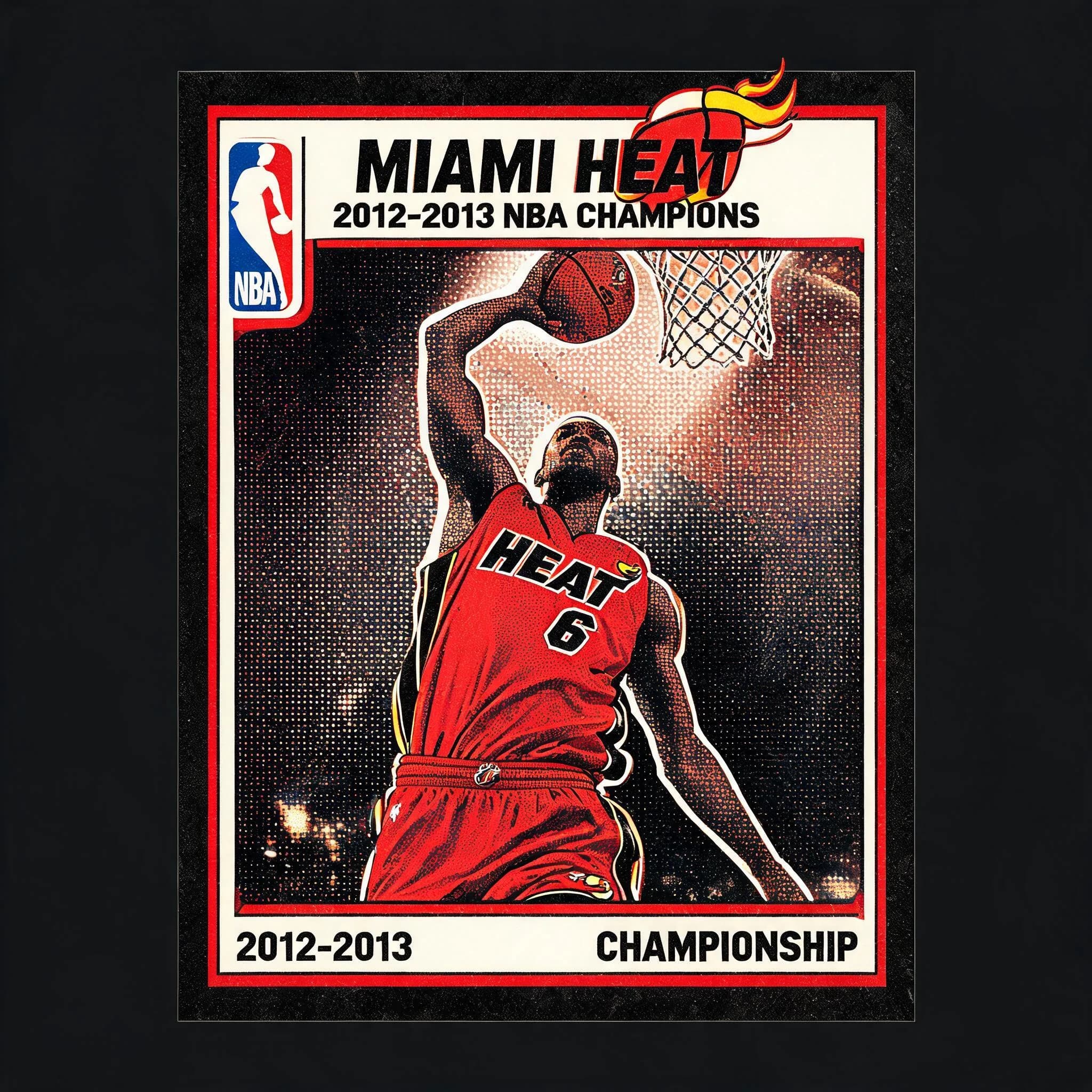
"Not one, not two, not three, not four, not five, not six, not seven..." LeBron James stood on a stage at American Airlines Arena in July 2010, promising a city championships before he'd played a single game in Miami red. The crowd screamed. The country cringed. And the #6 Heat jersey became the most polarizing piece of cloth in basketball.
For four years, LeBron in Miami red represented everything casual fans claimed to hate about modern basketball: superteams, player empowerment, guaranteed championships through collusion rather than competition. And for four years, LeBron in Miami red was also the most dominant basketball player on earth — two championships, two Finals MVPs, four straight Finals appearances, and a 27-game winning streak that remains the second-longest in NBA history.
The jersey absorbed both narratives. It's simultaneously a villain's costume and a champion's uniform. That duality makes it one of the more interesting pieces in the LeBron market.
The #6 Decision
LeBron chose #6 in Miami specifically to distance himself from Michael Jordan comparisons. "I just think what Michael Jordan has done for the game, I feel like no one should wear #23," he told reporters. The number choice was strategic branding: #6 was a clean slate. A new chapter, a new number, a new LeBron.
For collectors, #6 creates an instant authentication marker. Any "LeBron Miami" jersey with #23 is either fake or a custom. It also creates a finite window — LeBron wore #6 only during the Miami years (2010-2014), making it era-specific in a way that #23 (worn across three franchises) is not.
For detailed verification steps, see our authentication guide.
Championship Season Specifics
The smart money in LeBron's Miami market targets championship-season pieces:
2011-12 (First Championship): LeBron's redemption season after the 2011 Finals collapse against Dallas. He averaged 28.6 PPG in the playoffs. The Finals MVP trophy silenced the "can't win the big one" narrative. Jerseys specific to this season carry the 2012 Finals patch on the left shoulder.
2012-13 (Second Championship): The 27-game win streak season. LeBron shot 56.5% from the field — historically efficient. The Ray Allen Game 6 shot saved their season, and LeBron closed Game 7 with a triple-double. Back-to-back championship jerseys with the Finals patch are the grails of this era.
Why not 2010-11 or 2013-14? The 2011 Finals loss to Dallas (LeBron averaged 17.8 PPG in the Finals) creates a negative narrative for that season's jersey. And 2013-14 ends with the Spurs dismantling Miami in five games — not exactly the note you want on a display piece. The market agrees: championship seasons trade at 30-50% premiums over non-championship years.
The Red vs. White vs. Black Question
Miami offered three standard colorways during LeBron's tenure:
Home White: Clean, classic, Miami Vice–adjacent. The jersey LeBron wore for most home playoff games. Purists prefer it.
Road Red: The iconic look. Red with black and white accents. This is what most people picture when they think "LeBron Heat." It's the most produced and most available — but also the most recognized.
Alternate Black: The "Back in Black" alternate with red accents. Worn sparingly but visually striking. Lower production numbers mean slightly higher secondary market prices.
For a single-piece collection: buy red. It's the definitive LeBron Heat look. For long-term collecting: alternate black has stronger appreciation potential due to lower supply.
Authentication Guide
-
Template: Adidas Revolution 30 (2010-2014). Climacool mesh with hexagonal weave. Slim cut, lightweight.
-
Color: Heat red is an orange-red (not true red, not crimson). Compare against verified photos — fakes consistently skew too dark or too orange.
-
Number material: Multi-layer tackle twill. The #6 should have a white base layer with red outer layer, creating a dimensional effect.
-
Jock tag: NBA holographic logo shifts silver-to-rainbow. The Adidas trefoil should be clean and crisp, not blurry.
-
Size tag placement: Inside left hem, below the seam. Should include made-in country, material composition, and care instructions in multiple languages.
Learn proper storage techniques in our jersey care guide.
Design Anatomy: Heat Red in Detail
The Miami Heat's red jersey during LeBron's tenure (2010-2014) used the Adidas Revolution 30 template — the same platform that dressed the entire NBA from 2010 until Nike took over in 2017. But the Heat's implementation had distinctive characteristics worth understanding for authentication and appreciation.
The base color is not a standard red. Miami uses a specific orange-red pantone that sits between true red and vermilion. Under certain lighting — particularly arena lighting — the jersey can appear almost orange. Under natural daylight, it reads as a warm red. This color specificity is one of the fastest ways to spot fakes: counterfeit producers routinely use a generic red that skews too cool or too dark.
The "HEAT" wordmark across the chest uses a custom font with sharp, angular serifs and a slight italic lean. The letters are white with a black outline, layered in multi-color tackle twill on the authentic version. Below the wordmark, the #6 is rendered in the same treatment — white numbers with a black border, approximately eight inches tall on the front and ten inches on the back.
Side panels run from the underarm to the hem in black, creating a visual frame around the torso. A thin white pinstripe separates the red body from the black side panel — a subtle design detail that's often lost in photographs but immediately visible in person. The collar is a simple crew neck with black-and-white striped trim.
The back features "JAMES" in the same angular font, arching slightly across the shoulders. The nameplate is stitched onto the jersey as a separate piece on authentics (the stitching line is visible when you flip the jersey inside out). On replicas and swingmans, the name is screen-printed directly onto the mesh.
Historic Game Moments in Heat Red
June 21, 2012 — Game 5, NBA Finals vs. Oklahoma City. LeBron scored 26 points with 11 rebounds and 13 assists to close out Kevin Durant's Thunder and win his first championship. He wore the white home jersey for this game — but the red road jersey was worn in Games 1 and 2 in Oklahoma City, where LeBron combined for 60 points across two games to establish control of the series. The road red from the 2012 Finals is arguably the most valuable non-Finals-clinching jersey in LeBron's Miami collection.
March 27, 2013 — 27th Consecutive Win. The Heat defeated the Chicago Bulls to extend their winning streak to 27 games, the second-longest in NBA history behind the 1971-72 Lakers' 33-game run. LeBron scored 32 points in the red road jersey. The streak eventually ended at 27 two nights later in a loss to the Bulls. Jerseys from the streak games carry a niche premium among collectors who value regular-season milestones.
June 18, 2013 — Game 6, NBA Finals vs. San Antonio. The single most dramatic game of LeBron's career. Down 3-2 in the series, trailing by five with 28 seconds left, the Heat staged one of the greatest comebacks in Finals history. Ray Allen's corner three tied it, and LeBron finished with 32 points and 10 rebounds in the overtime win. He wore white at home, but the cultural gravity of this game elevates the entire 2012-13 season across all colorways.
January 16, 2013 — Career-High 61 Points (Narrowly Missed). LeBron scored 61 points against the Charlotte Bobcats on March 3, 2014, wearing the white home jersey. While not in the red, this game underscores the overall collecting narrative: LeBron's peak statistical performances overwhelmingly occurred during the Miami years, which concentrates collector demand on the 2010-2014 window regardless of specific colorway.
Comparing LeBron's Heat Red to Other Miami Icons
LeBron's Miami Heat jersey competes for collector attention within the franchise's own history:
-
Dwyane Wade #3 (2003-2016, 2018-2019): Wade is the Heat's franchise icon. His 2006 championship jersey (the pre-LeBron title) and his final-season pieces both trade actively. However, Wade jerseys consistently price 30-50% below comparable LeBron pieces from the same seasons, reflecting LeBron's broader global market.
-
Alonzo Mourning #33 (1995-2002, 2005-2008): Mourning's red-and-black jerseys from the Hardaway/Mourning era represent a different design generation entirely. There is almost no overlap with the LeBron buyer pool, but Mourning pieces offer a cheaper entry into Heat jersey collecting.
-
Shaquille O'Neal #32 (2004-2008): Shaq's Heat years — including the 2006 championship alongside Wade — produced jerseys that are modestly priced and undervalued relative to his Magic and Lakers pieces. A Shaq Heat jersey alongside a LeBron Heat jersey makes for a compelling two-player franchise display.
-
Jimmy Butler #22 (2019-present): Butler's "Bubble Jimmy" persona from the 2020 Finals against LeBron has created a growing secondary market for Butler Heat jerseys. Butler pieces are not in the same tier as LeBron but represent the clearest successor in terms of on-court intensity and cultural narrative.
Collecting Tips for LeBron Heat Jerseys
Target the Adidas Revolution 30 Authentic, not the Swingman. The Swingman was mass-produced and has held minimal value. The Rev30 Authentic — with stitched tackle-twill numbers and the Climacool mesh construction — is the collector's standard. Original tags and deadstock condition command premiums of 50-100% over comparable worn pieces.
The Finals patch is the dividing line. A 2012 or 2013 season jersey without the Finals patch is a regular-season piece. With the Finals patch, it's a championship artifact. The patch — a small rectangular emblem reading "The Finals" on the left shoulder — was applied only to jerseys produced for the Finals series. After-market patching (buying the patch separately and sewing it on) is common and detectable: factory patches have a specific adhesive backing that after-market patches lack.
Check the jock tag carefully. The NBA holographic jock tag on Adidas authentics from this era features a silver hologram that shifts through rainbow colors when tilted. Counterfeits typically have a flat, non-shifting hologram or omit it entirely. The tag should include the player's name, size, season year, and a unique serial number. If the serial number format doesn't match other verified examples, walk away.
The black alternate is undervalued. Most LeBron Heat collectors focus on the red, which is the most iconic colorway. But the black "Back in Black" alternate was produced in significantly lower quantities and commands slightly higher secondary market prices among informed buyers. If your goal is appreciation rather than recognition, the black is the sharper play.
Watch auction cycles. LeBron Heat jersey prices peak around NBA Finals time (May-June) and during LeBron milestone moments. They trough in the off-season (August-September). A patient buyer who shops in late summer can save 15-20% relative to in-season prices on eBay and Heritage Auctions.
Where to Buy
Affiliate links — we earn a small commission at no extra cost to you. Prices as of last update; click through for current pricing.
Acquire This Jersey
Affiliate links — we earn a small commission at no extra cost to you.
Resale Price Trend
+18.8%Collector Tools
Affiliate disclosure: Some links earn us a small commission at no extra cost to you. We only recommend products we'd buy ourselves.