JerseyTome Research Team
February 12, 2025 · 12 min read· Verified collectors & authenticators
A Dinosaur Named by Democracy
On June 15, 1993, Steven Spielberg released Jurassic Park. It made $914 million worldwide. Every kid in North America suddenly knew what a velociraptor was, could spell "Tyrannosaurus," and wanted to be a paleontologist.
Fourteen months later, the NBA awarded an expansion franchise to Toronto. The ownership group — led by John Bitove Jr. — needed a name. They had a $125 million investment and no identity. So they did something radical: they asked the public.
Over 2,000 name suggestions poured in. Towers. Huskies. Dragons. Bobcats. Tarantulas. The front office narrowed the list to ten finalists. Then they let fans vote. Not just any fans — they specifically courted schoolchildren, running ballot drives through Toronto's elementary schools and Boys & Girls Clubs. The reasoning was almost naive in hindsight: kids buy merchandise. Kids drag their parents to games. Kids are the future season-ticket holders.
The kids chose Raptors. Overwhelmingly. Not even close.
"Huskies" finished second in the vote and had serious historical weight — Toronto's original 1946 NBA team was called the Huskies. Ownership considered overriding the vote in favor of the Huskies until market research showed the name tested poorly with anyone under 25. The children's democracy held.
The Designer Was 26 Years Old
With a name locked, the franchise needed a visual identity. They didn't go to Nike's design lab or a Manhattan branding agency. They hired a small Toronto firm. The logo itself was primarily crafted by Milos Vujnovic at Raptors creative partner agency — his first major professional sports project.
The brief was deceptively simple: make it fierce, make it fun, make it sell to the kids who named it. The result was a red velociraptor — proportioned more like a basketball player than a prehistoric lizard — dribbling a ball, mid-stride, wearing sneakers. The whole thing was absurd. It was also immediately unforgettable.
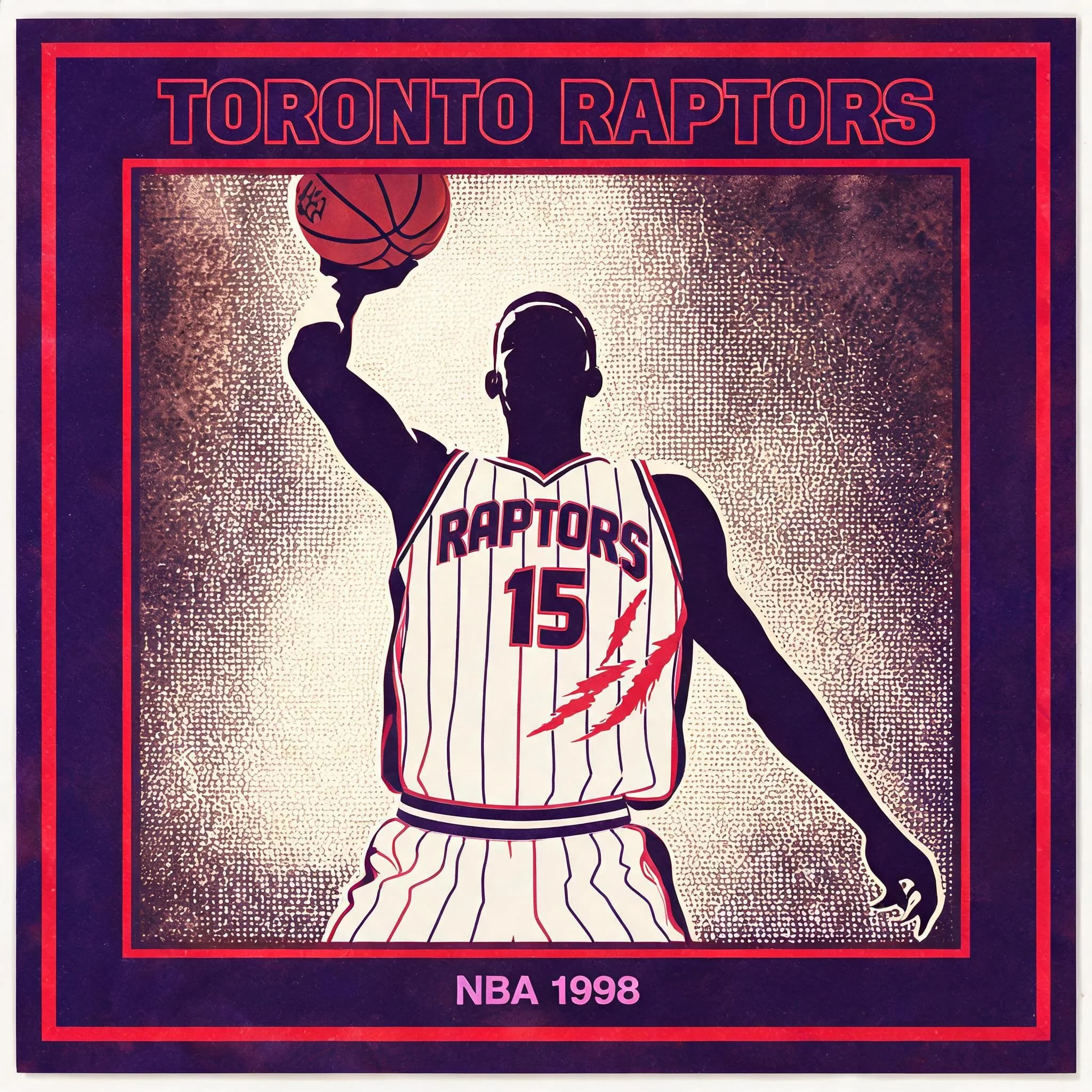
The color palette broke every rule. Purple as the primary — a color no NBA team owned at the time. Black and red as complements. Pinstripes running vertically on the road jerseys — the same design language Chicago would use for Jordan's black pinstripe a year later. The dinosaur itself wrapped around the body of the jersey on certain variants, its tail curling from front to back like a tattoo.
“We were young, we had no fear. Nobody told us you can't put a cartoon dinosaur on a professional basketball jersey. We just did it. And the kids went insane for it.”
— Milos Vujnovic, original Raptors logo designer
The Jersey Nobody Took Seriously — At First
When the Raptors unveiled the uniform in 1995, basketball purists reacted like they'd been personally insulted. Sports Illustrated ran a blurb calling it "what happens when you let the marketing department run the franchise." Charles Barkley, then with Phoenix, told reporters: "I ain't scared of no purple dinosaur. That's Barney."
The Barkley quote stuck. For years, opposing players would reference Barney the Dinosaur when playing Toronto. The joke became armor. The more people mocked it, the more Toronto fans clung to it. The jersey became a defiant identity marker: We're new. We're weird. We don't care what you think.
And it sold. God, did it sell. By the 1996-97 season, Raptors merchandise was outselling half the league despite the team winning only 21 games — making their expansion cousins, the Vancouver Grizzlies, look positively restrained. Kids in Tokyo wore purple dinosaur jerseys without knowing where Toronto was on a map. The design transcended basketball competence entirely.
Vince Carter's Dunk Contest: The Moment That Made It Sacred
February 12, 2000. Oakland. The NBA All-Star Slam Dunk Contest had been boring for years — a sideshow nobody cared about since Jordan and Dominique. Then a 23-year-old in a purple dinosaur road jersey walked onto the court and did things to a basketball that violated physics.
The between-the-legs windmill. The hanging elbow dunk. The 360 reverse. And that one — the one where Carter stuck his entire forearm through the rim and hung there, mouth open, like even he couldn't believe what just happened. Kenny Smith screamed "IT'S OVER! IT'S OVER!" before the final round even started.
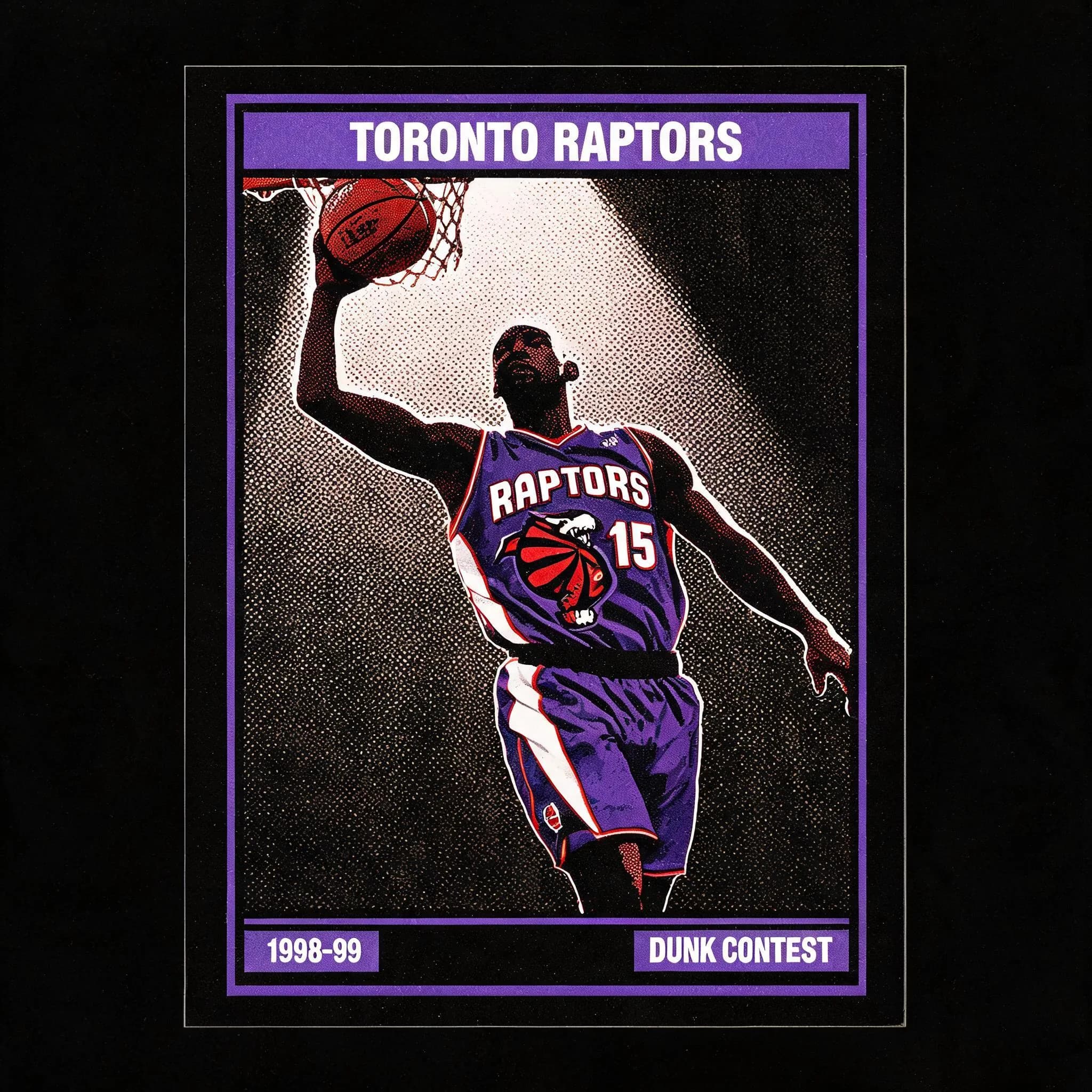
Every single dunk was performed in the purple pinstripe away jersey. Number 15. The dinosaur logo sitting on the belt line, almost smirking. In ninety seconds, Vince Carter transformed a jersey that critics called "cartoonish" into the most recognizable basketball uniform on planet Earth.
The next morning, Raptors merchandise sales increased 300% online. Purple dinosaur jerseys — not even Carter's name specifically, just the team jersey — sold out at every NBA Store location in North America by Monday.
Carter wore Nike Shox BB4s during the dunk contest — the first time the shoe was seen publicly. Nike had planned a quiet spring launch. After Oakland, they moved the release date up by two months. The Shox BB4 and the purple Raptors jersey are now permanently linked in sneaker-basketball mythology. A deadstock pair with original box sells for $800+ today.
Tracy McGrady: The Ghost in the Dinosaur
Everyone remembers Carter in the purple. Fewer remember that his cousin Tracy McGrady — drafted 9th overall in 1997, straight from high school — spent three seasons in the same jersey. Three seasons averaging a quiet 15.4 points by his final year in Toronto. Three seasons learning to be a superstar in the shadow of a louder one.
McGrady left for Orlando in 2000 as a restricted free agent. Toronto didn't match the offer. Within two seasons, T-Mac was a scoring champion, an All-NBA first-teamer, arguably the most talented wing in the league. He looked unrecognizable from the skinny teenager in the purple dinosaur jersey.
But the collectors remember. A McGrady Raptors jersey — authentic, from those three seasons — is now one of the most valuable non-Jordan jerseys of the 1990s. Because it represents the "what if": what if Toronto had kept both of them? What if the dinosaur jersey had dressed the greatest one-two punch in franchise history for a decade?
“I loved Toronto, man. I loved that jersey. But I was twenty years old and I needed to be THE guy somewhere. You can't be THE guy when Vince is doing what Vince does.”
— Tracy McGrady, reflecting in 2017
Why They Killed the Dinosaur
By 2001, the Raptors' front office was tired of the joke. Carter was a legitimate MVP candidate. The team made the playoffs for the first time. They wanted to be taken seriously — and they believed the cartoon dinosaur was holding them back.
The logic went like this: serious teams have serious logos. The Lakers don't have a mascot on their jersey. The Bulls' logo is angular and aggressive, not whimsical. If Toronto wanted free agents to consider them a destination, they needed to look like a franchise, not a children's birthday party.
So the dinosaur died. Replaced by a metallic claw mark. The purple faded to a darker red and black. The pinstripes disappeared. It was clean. Professional. Forgettable.
Within two years, Carter demanded a trade. McGrady was long gone. The franchise entered a decade-long rebuild. And the people who made the decision to kill the dinosaur probably never connected those dots — but the fans did. Symbolically, the moment Toronto tried to be something it wasn't, everything fell apart.
The Resurrection: Drake, Nostalgia, and the Championship
The purple dinosaur didn't stay dead. It couldn't. Nostalgia has a longer memory than corporate rebranding.
It started slowly — Drake wearing a vintage purple Raptors starter jacket courtside around 2013. Instagram exploded. Suddenly, thrift stores in Toronto couldn't keep old Raptors merch on the racks. Mitchell & Ness released a "Hardwood Classics" version that sold out in 48 hours.
By 2019, when the Raptors improbably won the NBA Championship with Kawhi Leonard, the dinosaur was everywhere. The organization brought back retro purple elements for the playoff run. Jurassic Park — the outdoor viewing area outside Scotiabank Arena — was named after the movie that named the team. Full circle, twenty-five years later.
The Championship parade was a sea of purple. Not the current red and black. Not the chevron design the team was actually wearing that season. Purple dinosaurs, everywhere, as far as the cameras could see. The people had spoken — again — just like those schoolchildren in 1994.
After Drake was photographed in a vintage purple Raptors jacket during the 2013-14 season, eBay listings for original 1995-99 Raptors jerseys increased by 640% within three months. Average sale prices jumped from $45 to $180. The "Drake bump" in Raptors vintage merch has been studied in at least two sports marketing academic papers.
The Collector's Price Guide
Pricing as of 2025-2026. Condition, authenticity, and player association drive enormous variance. Game-worn pieces exist in a different universe entirely.
How to Spot a Fake
The purple dinosaur is one of the most counterfeited jerseys in NBA history. Here's what to check:
1. The Jock Tag — Original Champion jerseys have a specific jock tag format: size on top, "Made in USA" or "Made in Korea" below, with a production code that corresponds to the 1995-1999 window. Fakes often use generic Champion tags from the wrong decade.
2. The Purple — The original purple is a specific shade — more violet than royal, with a slight red undertone. Counterfeits frequently nail the wrong purple, either too blue (like the Suns) or too red (like the Kings). Compare against verified auction photos, not Google Images.
3. The Dinosaur Placement — On authentic pinstripe jerseys, the dinosaur logo on the beltline is screen-printed, not embroidered. The tail should extend exactly 2.5 inches past the side seam. Fakes routinely get the sizing wrong.
4. The Pinstripe Alignment — Just like the Bulls pinstripe, the Raptors version must align across the front panel seam. Hold the jersey up to light and check the center join. If the stripes skip or misalign by more than 1mm, it's fake.
5. The Neck Tag Texture — Real Champion jerseys from this era have a slightly rough-textured neck tag with a specific font spacing. Chinese reproductions use a smoother tag stock. You can feel the difference blindfolded.
“The dinosaur jersey is our generation's Starter jacket. Everyone had one as a kid. Nobody kept it in good condition. And now everyone wants it back.”
— Chris Creamer, SportsLogos.net founder
What the Purple Dinosaur Teaches Us About Design Bravery
Here's the uncomfortable truth the NBA learned from Toronto: the "serious" approach to sports branding is often the forgettable one. Nobody has a metallic claw mark tattooed on their body. Nobody gets emotional about a chevron. But a purple dinosaur dribbling a basketball in sneakers? That lives in the chest cavity of everyone who was ten years old in 1995.
The Raptors' current management understands this now. The dinosaur returns as an alternate every few seasons. It always outsells the primary. It always generates more social media engagement. It always feels more alive than whatever the current design committee approved in a boardroom.
The lesson is transferable far beyond basketball. The things designed for joy — designed with the unfiltered enthusiasm of children who just wanted a dinosaur on a jersey — those are the things that endure. The things designed by committee, optimized for "mature brand positioning," die the moment the next rebrand cycle arrives.
Toronto let kids choose. The kids chose a dinosaur. And thirty years later, adults pay $3,000 to own a piece of that joy.
That's not nostalgia. That's proof that the children were right all along.
Where to Buy
Affiliate links — we earn a small commission at no extra cost to you. Prices as of last update; click through for current pricing.
Acquire This Jersey
Affiliate links — we earn a small commission at no extra cost to you.
Resale Price Trend
+25.0%Collector Tools
Affiliate disclosure: Some links earn us a small commission at no extra cost to you. We only recommend products we'd buy ourselves.