JerseyTome Research Team
May 9, 2026 · 10 min read· Verified collectors & authenticators
The Arrival
November 6, 1992. Shaquille O'Neal played his first NBA game for the Orlando Magic — and scored 12 points with zero turnovers in a loss to Miami. Modest. Unremarkable. Nobody knew yet.
By week three, everyone knew. Shaq was dunking so violently that he literally collapsed two shot-clock stanchions during his rookie season, pulling the backboard support systems down onto the court. The NBA had to reinforce every backboard in the league. One 20-year-old forced an infrastructure upgrade across 27 arenas.
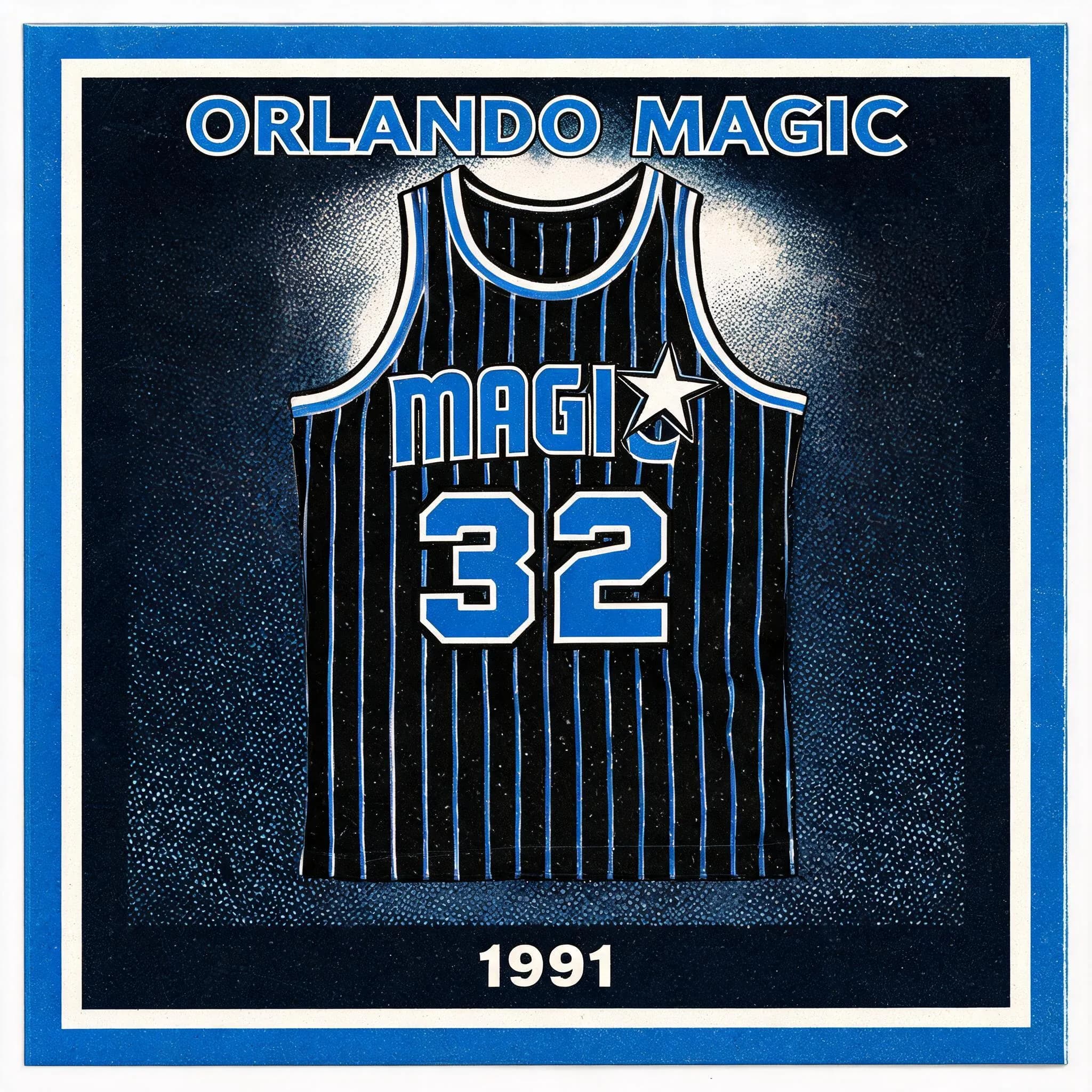
The Orlando Magic pinstripe jersey — black with white pinstripes, the blue-and-white Magic logo, and Shaq's #32 — became associated with a specific type of basketball spectacle: overwhelming, joyful, physically impossible dominance. Young Shaq didn't have the post moves yet. He didn't need them. He simply went through people.
Shaq broke the shot clock/backboard support during two separate games in his rookie and sophomore seasons. The NBA spent $1.5 million redesigning and reinforcing basket supports league-wide. Commissioner David Stern publicly joked that Shaq was "costing us a fortune."
The 1990s Pinstripe Phenomenon
Orlando's pinstripe wasn't just Shaq's jersey — it was the defining aesthetic of the mid-1990s NBA. The Magic's black-pinstripe uniforms were outselling every other team by 1994, including Jordan's Bulls. Young fans who didn't follow basketball bought Magic pinstripe jerseys as fashion.
This crossover appeal means Shaq Magic jerseys from this era attract two collector bases: basketball fans who remember the dunks, and vintage fashion collectors who remember the aesthetic. The pinstripe design — equal parts baseball reference and 1990s boldness — reads as "timeless" in a way that many 90s designs (looking at you, teal Grizzlies) don't quite achieve.
Four Seasons, Then Gone
Shaq left Orlando for the Lakers in 1996 as a free agent — one of the first major "superstar leaves" moments in NBA history. He'd taken the Magic to the 1995 Finals (swept by Hakeem Olajuwon's Houston Rockets, whose championship red jersey represents the other side of that series) but couldn't get back. The departure was contentious. Orlando fans felt abandoned.
That four-season window (1992-1996) creates natural scarcity. The Magic were a young franchise in a mid-size market. Merchandise production was lower than Lakers or Bulls equivalents. Champion (the manufacturer) produced fewer Orlando authentics than they did for large-market teams. Surviving originals from this window are genuinely rare.
The Size Factor
Every Shaq jersey discussion must address the elephant in the room: size. Shaq wore a 58. Normal retail went up to 48 (XL) or 52 (XXL). This creates a fascinating collector's dilemma:
Game-worn size (58): These are display pieces. They cannot be worn by anyone except perhaps an offensive lineman. But they're real — the fabric is cavernous, the proportions are startling, and the physical impact of holding one is unlike any other jersey in collecting. Authentication is simplified because the size itself is a verification tool.
Retail authentic (44-52): These are wearable but lose the Shaq-specific drama. A size-48 Shaq jersey looks identical in proportion to any other player's jersey. The "bigness" that defines Shaq as a cultural figure is completely absent.
For pure collecting value, oversized game-issued or game-worn pieces command the highest premiums. For wearing and personal enjoyment, Mitchell & Ness standard sizing is the practical choice.
Authentication Notes
For a comprehensive guide to Champion-era NBA jersey verification including tag dating, mesh weight assessment, and fight strap identification, see our full authentication guide.
-
Champion tags (1992-1996): Look for the Champion "C" logo inside collar and size tags on left hem. Champion used a specific mesh template for Magic jerseys that has a wider knit pattern than their other NBA teams.
-
Pinstripe alignment: On authentics, white pinstripes align perfectly across the center seam. This is the fastest fake-check — counterfeits routinely misalign at the front panel join.
-
Size verification (game-worn): Any claimed "Shaq game-worn" under size 54 is fake. Period. His smallest known game jersey is a 56, most are 58-60.
-
Color accuracy: The black should be true black (not off-black or charcoal). Pinstripes are pure white — not cream, not off-white.
Design Breakdown: Why the Pinstripe Works
The Orlando Magic pinstripe jersey is a case study in 1990s design that transcended its era. The base is true black — a bold choice for a team that entered the NBA in 1989, just three years before Shaq arrived. Most expansion teams of that period chose safe, conservative designs. Orlando went aggressive.
The white pinstripes run vertically from shoulder to hem, spaced approximately three-quarters of an inch apart. They narrow slightly at the shoulders and widen at the torso, creating a subtle visual effect that makes the wearer appear broader. On a player Shaq's size, the effect was almost comical — the pinstripes accentuated his already massive frame.
The "MAGIC" wordmark sits across the chest in a custom serif font with a subtle arc. The lettering is white with a thin blue outline, a layering choice that gives the text dimensionality without overwhelming the pinstripe pattern. The player number appears below in the same treatment. On the back, the player name runs straight across the shoulders in a smaller version of the same font.
The side panels are solid black, breaking the pinstripe pattern and creating a slimming vertical line — an ironic design choice given Shaq's build, but one that makes the jersey look cleaner than a continuous all-over pinstripe would. The collar is a simple V-neck with a thin blue-and-white striped trim, matching the waistband.
What makes this design endure is restraint. The black-and-white palette with blue accents avoids the neon-tinged excess that doomed many 1990s jerseys to eventual embarrassment (the Toronto Raptors' original purple dinosaur, the Detroit Pistons' teal horse). The pinstripe motif borrows from baseball's timeless visual language, grounding the jersey in a broader sportsware tradition that reads as sophisticated rather than trendy.
Key Moments in the Pinstripe
November 24, 1993 — The First Backboard. Shaq's first backboard-collapsing dunk came in his second season against the New Jersey Nets. The shot-clock stanchion buckled under the force, and the game was delayed for 35 minutes while crews replaced the entire apparatus. The footage — Shaq hanging from the rim while hardware crashes around him — became one of the defining highlights of the 1990s. He was wearing the black pinstripe road jersey.
1994-95 Season — The Finals Run. Orlando's miracle run to the 1995 NBA Finals was the franchise's finest hour and the pinstripe jersey's peak cultural moment. The Magic swept Michael Jordan's Bulls in the second round — one of the greatest upsets of the decade — before falling to Hakeem Olajuwon's Houston Rockets in the Finals. Shaq averaged 28.0 points and 12.5 rebounds that postseason. Jerseys from the 1994-95 season carry a premium over other Magic-era Shaq pieces specifically because of the Finals appearance.
The Penny Partnership. Anfernee "Penny" Hardaway arrived in 1993, and the Shaq-Penny duo wearing matching pinstripes became the most marketable young tandem in the league. Nike built the "Lil' Penny" ad campaign around Hardaway, and the two players in black pinstripes dominated magazine covers and poster sales. This dual-star marketability boosted Magic merchandise sales to levels that rivaled much larger markets.
Comparing Shaq's Magic Pinstripe to Other 1990s Grails
The Shaq Magic pinstripe exists in a specific collector's tier alongside other 1990s design icons:
-
Michael Jordan Bulls Black Pinstripe: The Bulls' alternate pinstripe (introduced 1995-96) is the most direct comparison. Jordan's version commands higher prices due to his broader collector base, but the Magic pinstripe is arguably the more distinctive design — the Bulls version was an alternate, while Orlando's was the primary road jersey.
-
Vince Carter Raptors Purple: Carter's Toronto jersey shares the 1990s expansion-team energy and the "young star in a bold design" narrative. Carter prices have surged since his Hall of Fame induction. Shaq Magic pieces are more stable but lower-ceiling.
-
Vancouver Grizzlies Teal: The ultimate 1990s nostalgia piece, but purely design-driven — no single player dominates the Grizzlies jersey market. Shaq's Magic pinstripe has both design appeal and player-specific gravity, which gives it a wider buyer base.
-
Charlotte Hornets Teal (Larry Johnson/Alonzo Mourning): Similar era and expansion-team pedigree. The Hornets teal is slightly more accessible in price but lacks the Finals-appearance narrative that anchors the Magic pinstripe.
Collecting Tips for Shaq Magic Jerseys
Condition is everything on vintage Champion. The Champion mesh from this era is durable but prone to two specific issues: yellowing of the white pinstripes (from improper storage or smoke exposure) and cracking of the screen-printed numbers on replica-tier jerseys. Always inspect pinstripe color under natural light — fluorescent lighting can mask yellowing.
The fight strap test. Authentic Champion jerseys from this era include a "fight strap" — a small loop of fabric sewn into the interior back hem, designed to tuck into the player's shorts and prevent the jersey from being pulled over the head during altercations. Replicas omit this detail. It is the single quickest way to separate authentic from replica in the Champion product line.
Watch for the 1995 Finals patch. A small rectangular patch reading "NBA Finals 1995" appeared on the left shoulder of jerseys worn during the Finals against Houston. Retail authentics with this patch were produced in very limited quantities — Orlando was not expected to reach the Finals, and Champion did not have large pre-production runs ready. Surviving examples with the Finals patch trade at 2-3x the price of standard-season equivalents.
Mitchell & Ness reissues are not scarce. Mitchell & Ness has reissued the Shaq Magic pinstripe multiple times across their Hardwood Classics and Authentic lines. While the quality is excellent, these reproductions will never appreciate meaningfully because Mitchell & Ness can — and does — reprint them whenever demand warrants. Buy Mitchell & Ness to wear. Buy Champion originals to collect.
Frame for display, not for resale. If you're framing a Shaq Magic pinstripe, use a shadow box deep enough to accommodate the jersey's bulk without compression. The pinstripe pattern shows creasing more visibly than solid-color jerseys, so any fold lines will be permanent and visible. Acid-free backing and UV-filtering glass are non-negotiable for pieces valued above $300. Our jersey care guide covers framing specifications, storage protocols, and long-term preservation techniques for vintage Champion pieces.
Where to Buy
Affiliate links — we earn a small commission at no extra cost to you. Prices as of last update; click through for current pricing.
Acquire This Jersey
Affiliate links — we earn a small commission at no extra cost to you.
Resale Price Trend
+20.0%Collector Tools
Affiliate disclosure: Some links earn us a small commission at no extra cost to you. We only recommend products we'd buy ourselves.